“Կուզես կոֆե՞”
This is a phrase I have heard everyday in Armenia. It means “will you drink coffee?” My answer is always yes.
Incase you didn’t know, the world is divided into tea and coffee drinkers. Armenia, like usual, is caught between the East and the West. People drink coffee and tea everyday– but I feel like coffee has a slight edge. Every morning is a three beverage morning, first tea, then kompote (juice), then coffee. There’s always time for coffee in Armenia, even if you’re running late.

At home I had strict limits to my coffee. I would only have two cups a day, I exclusively drank iced lattes, and I never drink it after noon, otherwise I wouldn’t be able to fall asleep that night. All that flew out the window once I came to Armenia. Here I drink about three to four cups a day, and often late in the afternoon or evening. The most I’ve had in one day is seven. Armenia has taught me how to like black coffee, something I avoided back home because I never had the taste for it.
The coffee here isn’t filtered drip coffee like we’re used to back home. Armenians call it ‘haykakan soorj’– Armenian coffee. It’s very strong, dark coffee made with finely ground coffee beans. My PST host family owned a small vegetable store, where they also ground coffee. Soorj has a very rich and comforting smell, and when it’s being prepared the kitchen smells strongly of it.
Before preparing the coffee, a set of teacups and saucers are laid out. Armenians take a lot of pride in their coffee cups. These cups are very charming, they’re small and you balance them on top of the saucer when you drink. Because the cups are smaller, you savor the coffee when you drink. It seems like no two coffee cup sets are alike, each family has their own set– each unique. More ornate sets are pulled out of closets and cabinets when guests come to visit.
Armenian coffee is prepared on the stove with something called a srjep/jazva (սրճեփ/ժազվա). A spoonful of soorj is put in for each cup being prepared, and water is poured in at a 1:1 ratio. The heat of the stove is turned on high and you must watch the coffee until it starts to foam. If you turn your back, it’s guaranteed to boil and spill over. When it begins to foam, you take it off the heat, stir, and repeat once more.
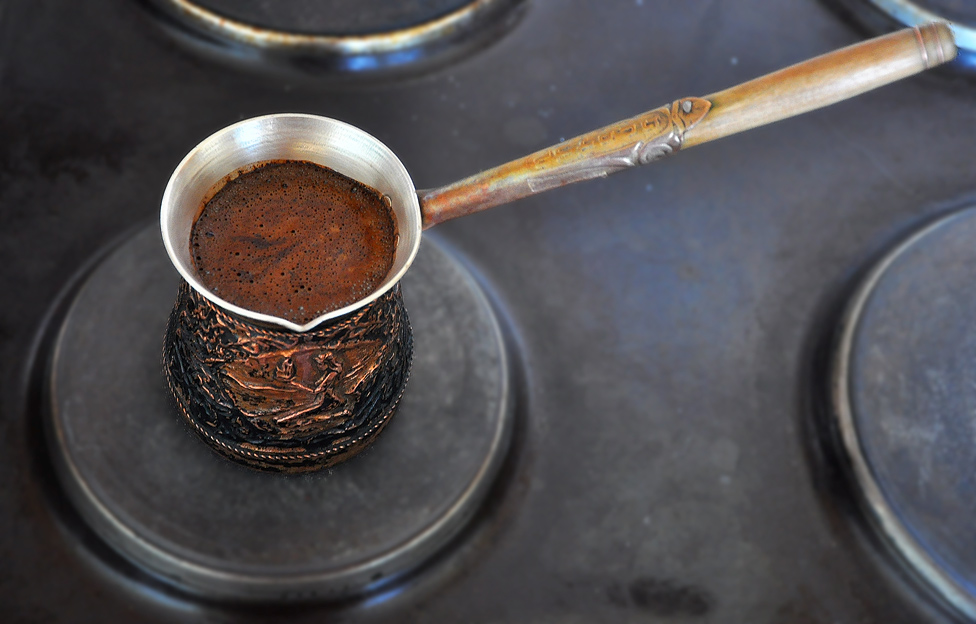
Then, the coffee is poured into the teacups, just until the lip of the cup. An unspoken rule here is to never serve a cup of coffee that is not filled to the brim. What’s important about coffee here is not just the coffee itself, but the rituals around it. Sitting and drinking with family, reading coffee grounds, being invited into a total stranger’s home for a cup, a tray full of cups brought out after a big meal.
Something that has been stressed during our PST is the concept of ‘Armenian Time’– I think to understand Armenian time, you have to understand these rituals.
‘Armenian Time’ is a concept I’m still trying to understand. For most Americans we might simply think that Armenians have a habit of being late, or that they don’t keep track of time. This isn’t the case when you start to participate in what we might consider ‘wasting time’ back home.
I’ll give you an example. This week I moved to a permanent site, and I booked an appointment to get my nails done. The morning of the appointment, I was rushing around, worrying I would be late. My host sister sat me down at our dining room table, and made me a cup of coffee. I was thinking– I have to be out the door in five minutes, so I can walk for 15min– then get to the place early so I don’t waste my nail tech’s time. My appointment was at 11:00, and coffee was put on the table at 10:55. I drank it and left our home at 11:15.
I was late, but it was fine because when I arrived at my appointment, there was another cup of coffee waiting there for me. (my third of the day)
What coffee represents here is an invitation for connection and relaxation. There’s an implicit understanding that time slows down just enough for you to finish your cup. Candy and fresh fruit is set out for you to enjoy after you finish your glass, another bid for your attention. For Americans time is money, but for Armenians time is care- – brewing cannot be hurried, the drinking should be savored, the conversation that follows flows according to its own natural rhythm rather than any external schedule. This creates a sanctuary within ordinary time, where the pressures of productivity and efficiency are set aside in favor of connection, calmness, and nourishing relationships.
For Americans and other Westerners, this coffee culture might also come with culture shock. It’s a reordering of our values. Time is not a finite resource here. My idea of time as something that shouldn’t be wasted is constantly challenged, and being replaced with opportunities to build intimate relationships and pause before a busy day. For Armenians, time is given generously– often through an invitation for coffee.

what the table might look like if you’re invited to drink coffee in Armenia
 mary-go-round
Leave a Reply, Email is Not Recorded