Before I moved to Armenia, I never danced.
I’ve always loved dance as an art form. If I could go back and change something in my past, I would have my parents force me to stick with ballet.
I’ve spent hours of my life watching videos of people dancing. Mikhail Baryshnikov launching himself across the stage at the New York Ballet, Argentinian dancers twisting themselves into and away from each other as they dance Tango, groups of mop-haired Adidas-clad twenty somethings shuffling around dim dance halls to Northern Soul.
When I watched these videos, I felt envy and an ache. I admire the mastery dancers have over their bodies. Each gesture and line they create is intentional and deliberate. I love the complete control & release dance gives. I love it’s physicality, the presence of people in their own bodies. I love the tension between artistic expression and technical precision. But it was something I never felt like I could do. I felt stiff and hesitant, I judged myself harshly. I didn’t have the confidence I needed try.
What changed was simply my being in Armenia. As a Peace Corps volunteer, you’re making a fool of yourself a little bit everyday as you learn a new language, commit cultural faux pas and figure out how you’re going to make it the next two years. This has great consequences for your self confidence, if you let it.
When I landed in my training village, the first thing I figured out was where I could take dance lessons. I thought it would be a good way to integrate into my community. I practiced with Tsliq (Sprout) folk ensemble, a dance troupe of kids who eventually I would perform with at my swearing in ceremony.
With them, I learned how to dance Yarkhushta. Yarkhushta is a martial dance traditionally performed by men that comes from the Sasun region of Western Armenia. It imitates rams, high up in the mountains, pausing for a moment before they strike each other. To dance Yarkhushta correctly, you need to look your partner in the eye– a challenge. When I was learning, my instructor Mikqael told us that we needed to hit each other so hard that our hands burned and our veins ached.
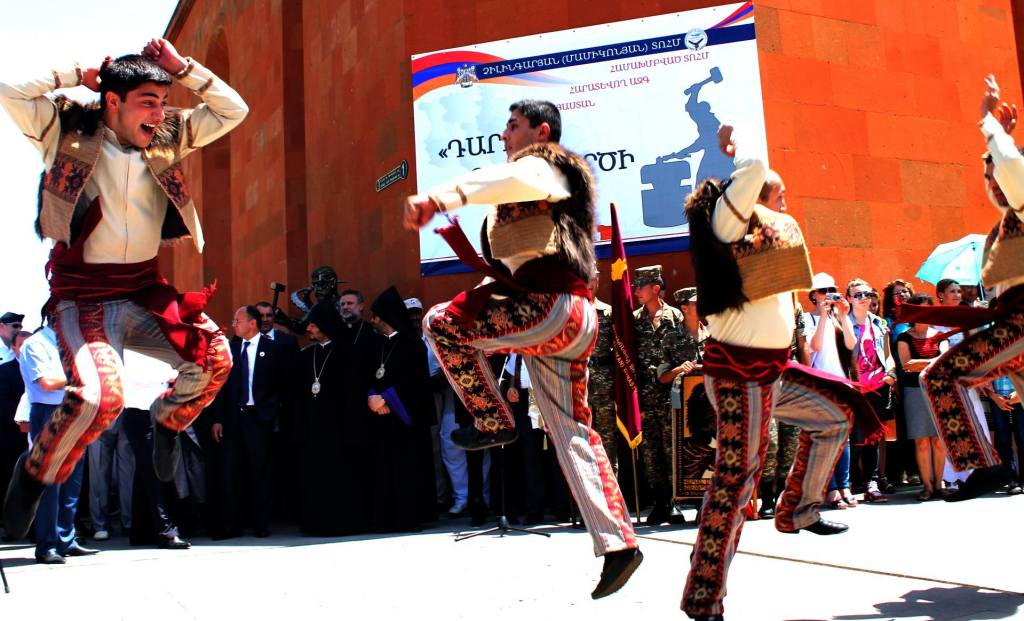
Armenian dance makes your blood run hot and your cheeks burn. Your emotions well up inside you when dance Yarkhushta or Kochari. There is a certain kind of intensity that pulses through these dances, and a range of emotions that accompany it. It is not just rhythm and choreography, it is an inheritance of a culture that spans centuries & that has fought off extinction. These dances carry the weight of mountain ranges spanning Anatolia and the Caucasus. They are containers of story, of grief held together by pride, of silence turned into movement, and joy in resilience.
The defining emotions of Armenian dance are defiance and passion. To understand what it means to dance them, you have to know where they come from, homelands that modern Armenians do not have access to. They are passionate dances because they are dances that have endured. When you perform them or even just witness them there’s a rush that rises up: pride, joy, grief & urgency all in one. Dancers whoop and shout while performing, the emotions conjured and felt expanding out past the movement they are creating.
As I have learned to dance here, I am taken aback by how much pride I feel for a nation I am not a citizen of, and that I share no blood with. Learning these folk dances has tethered me to the country I serve in a way that feels immediate and personal. Dance is one of those rare parts of culture that’s intangible. It can’t be held, only felt–and yet it leaves such a lasting imprint.
My reasons for wanting to dance have changed over time. Back home, I saw dance as a form of physical control– something that required discipline, precision, and mastery over the body. It appealed to my desire to be exact, to achieve a level of perfection, to feel in command of myself.
Here, immersed in dances that are raw, communal, and full of emotion, I have begun to understand that the most powerful dancing is not about control, but release into a legacy larger than yourself.

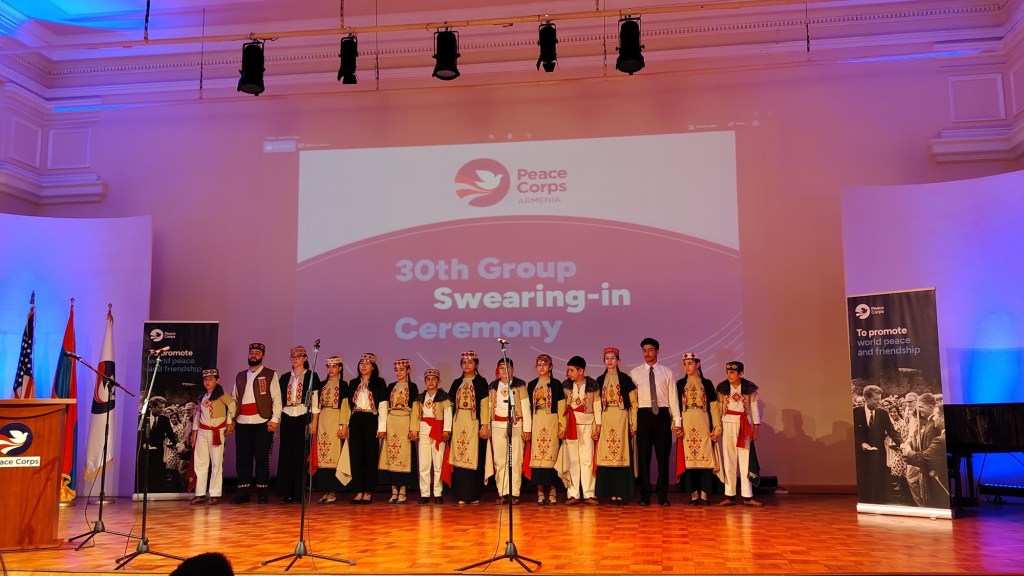

- Me dancing Yarkhushta at my swearing in ceremony
- Rehearsal for swearing in
- Tsliq folk dancers
 mary-go-round
Leave a reply to observationmy121f2350c1 Cancel reply