Armenia is a nation of contradictions. East and West, ancient and developing, untamed and connected. For me, these contradictions can be understood in the differences between its two largest cities, Yerevan and Gyumri.
Two mountains appear in the background and stories of these cities. In Yerevan, Ararat towers over pink tuff, traffic and new developments. You can’t look at Ararat without feeling a pang in your chest, knowing what it means to Armenians. In the north, Aragats sits calmly in the distance, watching over the remaining blackstone buildings of Gyumri’s historical center. It’s Armenia’s tallest mountain within it’s modern borders, a source of debate recently.

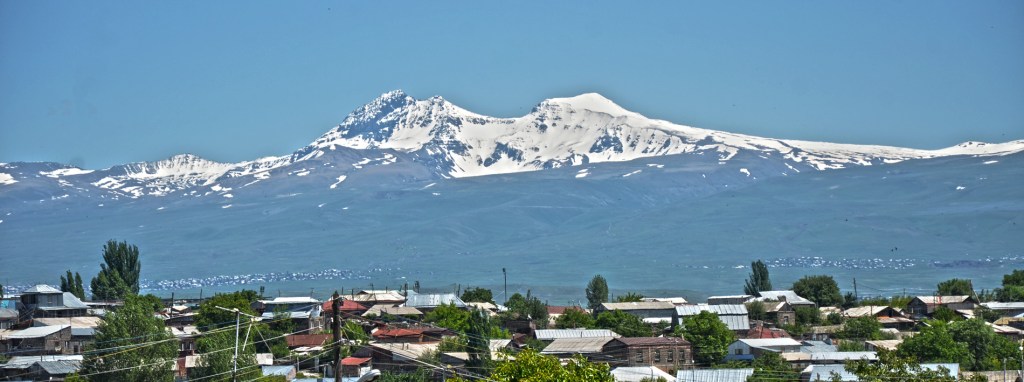
The two cities both have over 2,000 years of history. Yerevan is Armenia’s mayrakaghak, Gyumri is often called Armenia’s hayrakaghak. It’s two capitals. Mayr means mother in Armenian, Hayr means father. Yerevan holds the majority of Armenia’s population, 1.1 million people call it home. Gyumri is a city of only 120,000 (That’s the size of Ann Arbor, for my Michiganders reading this). Only 75 miles separate them, but they have their own distinct cultures and atmospheres.
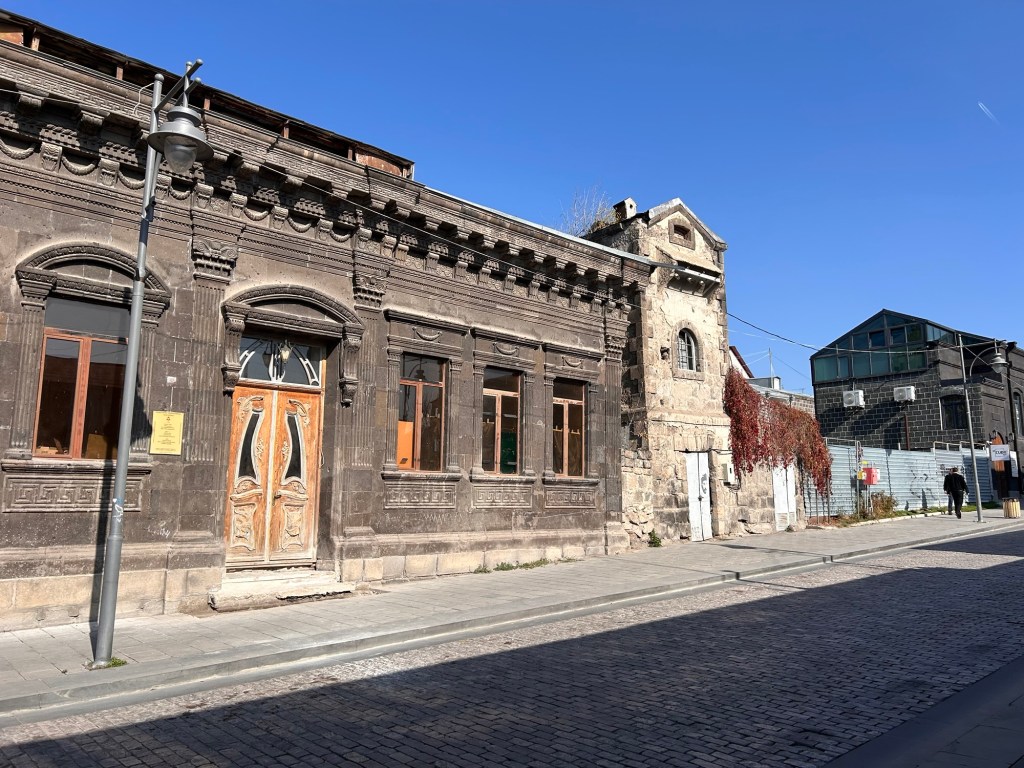
Gyumri’s face is stony but charming. It sits in the north, on a flat plain that is windblown and cold in the evenings. In 1988, 80% of the city was destroyed by a 6.8 magnitude earthquake. It has since been rebuilt, holding onto it’s historical façade. Short in stature, cobbled streets, ornamented doorways, Gyumri is a living window into Armenia’s past.
Hints of the city’s standing as the cultural capital are everywhere, statues to its great poets and actors, ornate stone carvings that adorn its buildings and expertly smithed drain pipes and wrought iron gates. Gyumri’s face is connected to Western Armenia, it’s buildings and their flourishes are similar to that of Kars. When I’m walking here in mornings, on its quiet, cool streets, I feel like I’ve been taken back half a century.
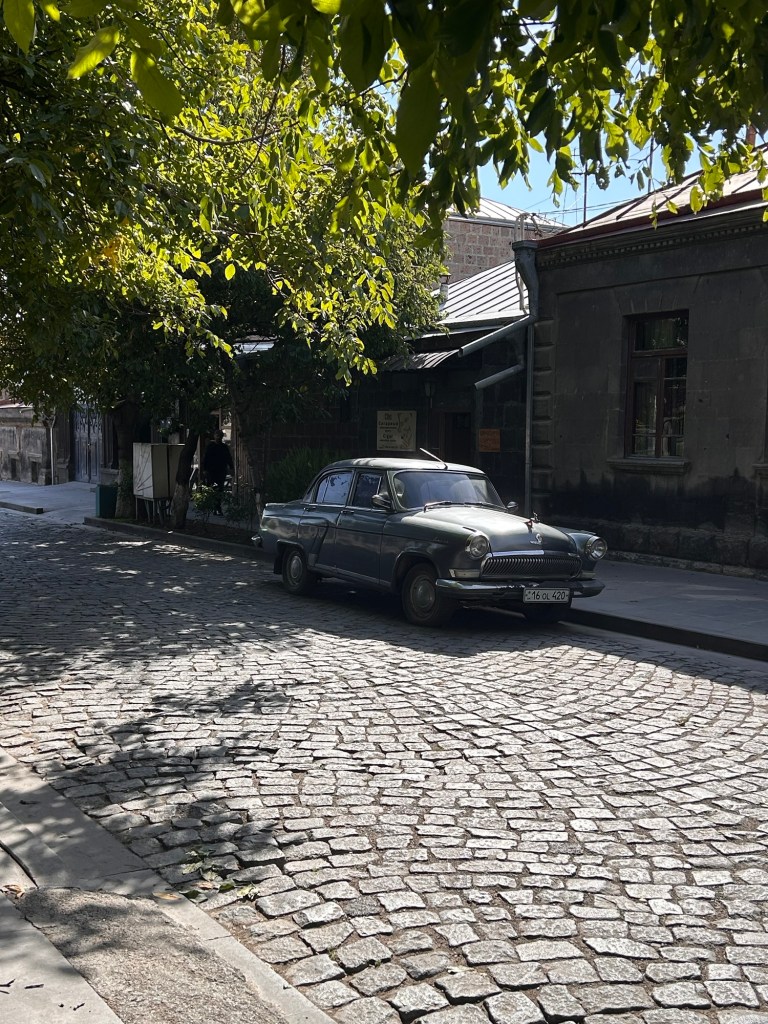
Gyumrecis (people from Gyumri) are proud of where they are from. Gyumri is not just Gyumri, it is ‘մեր Գյումրի’ (Our Gyumri). Gyumrecis are known for the sense of humor and the nicknames they give people, the dialect people speak here seems to lend itself to jokes. It’s bouncy and playful, Armenians describe it as rough. Gyumri has had many names, Kumayri, Alexandrapol, Leninakan, each reflecting a different part of its history. Even the city itself can’t escape its nicknames, locals call it Lenakan and call themselves Lenakanci.
Gyumri’s dialect differs strongly from standard Armenian, it’s closer to Western Armenian, strongly preserved by its speakers but not officially recorded. After returning from a work trip to Yerevan, my host sister shared with me that she doesn’t change the way she speaks when she’s in the city:
“It’s our language, it’s the way I speak. All of us Gyumrecis stand and talk together like we’re standing here.”
It’s hard to deny a paternal quality to Gyumri, since it is the hayrakaghak. The city and its people don’t save face when they show you who they are. The stone facades and ruins left behind make a statement about this place’s history. Gyumrecis are expressive, and quick to crack jokes. They are resilient, they are protective. Speak a few words in the dialect and they’ll be calling you a Lenakanci too.
Gyumri’s identity lays in its sense of tradition and the pride of its locals. There’s this sense of nostalgia and a reluctance to move on, but in a way that charms you. The streets are moody, maybe a bit sleepy, but they embrace you anyway.
Yerevan’s soul can’t be found in Center Avenue or on the top of the Cascades. It’s inside its gardens contained in Soviet era courtyards and within vine-tangled balconies. Tucked just out of sight, and in the people that call the city home. I can show you photos of the city, it’s shady parks and the buildings rose-stained at sunset, of Republic Square sparkling at night, but Yerevan’s feeling is something that can only be experienced.
What strikes me most about Yerevan, especially as someone who has made Armenia home, is how authentic this city is. You see how people actually exist here, morning routines, the evening strolls, the patterns of neighborhood life that repeat with comforting predictability. There is a rhythm to life here that asks you to engage with it, to get curious.
I see Yerevan as a city for families. Children are adored in Armenia, but it seems like even more so in Yerevan. People stop strollers on the street to say hello to newborn babies, inch their cheeks and call them beautiful. In the parks, kids are with their whole family, mom, dad, stewarded by either papik or tatik.
Summer in Yerevan belongs to children. The heat is heavy during this time the year, sitting close to the skin and impossible to escape. The stores are filled with a hundred different kinds of marozhni (icecream). Public fountains transform into water parks, crowded with kids in splashing and shrieking while their parents sit nearby, chatting and sipping on something iced from Coffee House. The city feels safe in a way that’s increasingly rare, children are afforded an independence here that they aren’t back home in America.
Yerevan reminds you how Armenia is striving, almost straining, to change and reinvent itself. Even though the city is ancient, this legacy is hard to find. Walk through the Kentron district and you’ll find wine bars pulsing with new music, sleek galleries and jazz clubs filled with smart and stylish young people. Each of these places are distinctly Armenian, from their style to their music choices.
This transformation isn’t uniform or without tension. Soviet architecture still dominates much of the skyline, its brutalist blocks sitting alongside newer buildings. Old repair shops and family-run bakeries operate next door to specialty coffee roasters and design studios. Fresh fruit stands next to the newest branch of Yerevan City. The city exists in multiple time periods at once, and you can feel the pull between tradition and progress on every corner.
Above all, there is romance to the city, and it has to be experienced at eye level. The city glows pink and gold, its people radiate warmth. It’s authenticity is so bewitching that it begs to be captured, photographed or painted, but Yerevan’s atmosphere is impossible to document without living it. This is what it means for Yerevan to be the mayrkaghak—the mother city, the capital, but more than that, a beating heart of Armenian identity in the present tense.


Armenia’s contradiction is that it is remaking itself as it is carrying its history. Yerevan and Gyumri tell different stories about what it means to be Armenian today, how the weight of history both drives change and holds it back, how tradition can push you forward even as it keeps you in place.
To understand Armenia, look to the hayr and mayrkaghark. They both have their own story to tell.
 mary-go-round
Leave a reply to Mollylouise Cancel reply