My next door neighbor here in Armenia is an officer in the Russian army. I’m sure it looked suspicious when a young, single, American, who speaks Armenian, moved into the apartment next door (which has a very convenient view of where my neighbor takes his smoke breaks).
It doesn’t help my case that one of my hobbies is birdwatching. I’m often staring out the window with a pair of binoculars.
Under the comments of A30’s swearing-in livestream, a comment appeared, essentially calling us ‘spies with smiles’. A year later, after the swearing in ceremony of the A31 group of volunteers, Peace Corps appeared in a Russian propaganda telegram channel. Apparently we aren’t tourists or English teachers, but a “vanguard of creeping annexation” whose stay in Armenia is akin to a military operation.
One of the controversies or critiques of the Peace Corps is that we’re essentially an arm of American intelligence. It’s a tidy myth, undone by the agency itself: the CIA won’t hire a Peace Corps volunteer for five years after their service, and a returned volunteer can never work for the CIA in the country where they served. We’re barred from intelligence work while we’re here, barred from an intelligence background before we arrive, and if a family member works in intelligence, we get vetted accordingly. These boundaries have held since the organization’s earliest years.
All this to say my neighbor can enjoy his smoke breaks in peace, I really am just trying to look at the birds perched in the tree next to our shared yard.
But the false implication of spy craft, and my neighbor’s imagined perception of me raised some questions. Essentially, can soft power ever be soft if you are a world power? If your country is a colonial, imperialist power?
It’s hard to apply to Peace Corps without considering America’s history. I could not stomach serving in Vietnam or Cambodia, where our bombing campaign, referred to here as the American War leaves unhealed scars and generational birth defects. I cannot stomach promoting American soft power in places like Colombia, Guatemala or Ecuador where shadowy American-led operations have influenced elections and toppled democratically elected leaders. Distrust of American systems is well deserved.
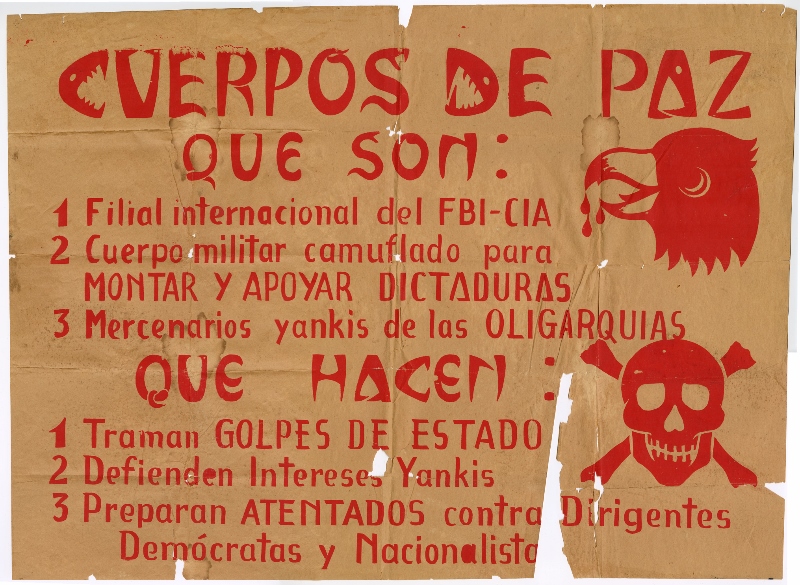
Translation:
“The Peace Corps is:
1) an international affiliate of the FBI-CIA,
2) a military corps that supports dictatorships, and
3) yankee mercenaries of the oligarchies.
What do they do:
1) plot coups,
2) defend yankee interests, and
3) prepare attacks against democratic and nationalist leaders.”
I thought the implications of an American serving in Armenia would escape some of these narratives, but now I’m questioning my presence here as well. Armenia’s modern Neo-colonial parent state is Russia. With the re-election of Pashinyan this June, Armenia has taken a western facing stance, which Vladimir Putin isn’t very excited about. As an American volunteering here, I feel like I’m playing out the same commies vs. capitalists-red-scare-proxy battle of the Cold War, albeit at a much, much smaller level.
There are aspects of Peace Corps approach that are anti-colonial. As Peace Corps trainees, it is drilled into you that your number one priority is integration. You are taught to set aside your expectations, assumptions and to do as the locals do. Every action, set back, success and challenge, you are asked to consider and integrate through the cultural lens of your country of service. Language is an extremely integral part of integration, and Peace Corps Volunteers are expected to become proficient in their country’s language, and even the local dialect.
“To speak a language is to take on a world, a culture“
–Franz Fanon
“Քանի լեզու գիտես, այնքան մարդ ես“
How ever many languages you know, that many times a person you are
–Armenian Proverb
As volunteers, you are also asked to say goodbye to the material comforts that so many Americans take for granted and view as a given right of living in ‘the greatest country on earth’. Many Peace Corps volunteers walk miles to pump their water from a well, then wait as that water is sanitized to drink it. Laundry is hung out to dry in the open air. Electricity can be prone to brown outs, and you soon forget what the speed of 5G internet and instantaneous streaming is like. Part of the structure of Empire rests on the hoarding of resources. “Wealth is not the fruit of labour but the result of organized, protected robbery” (Franz Fanon, Wretched of the Earth.) Excess is justified by the Empire asserting itself as the ‘winner’ of history, therefore entitled to its spoils.
Peace Corps service also demands that you renegotiate your so-called Western Values. Your sense of time becomes more flexible, family relationships become expansive and interwoven, friendships deepen and require more authenticity, the community of your site welcomes you slowly you as you try to offer your help to them, personal space shrinks, comfort takes on a different definition. This list is one that keeps on growing as you continue through your service.
At the same time, all of these aspects of service are temporary. At the end of two years, we go home. The people we serve remain here. The projects and plans we collaborated may or may not continue. Often times the impact of service is heaviest on the life volunteer, rather than the community they came to serve. This is both positive and complicated. Peace Corps service gives you a window into much of the global inequality Americans are sheltered from, but our position of volunteers can reflect a certain savior complex.
So here I am in Armenia, serving in a country that is looking West but didn’t ask for my opinion, my help, or the American values that I am supposed to be promoting.
What we’re also taught, instead, is service’s small, individual impact. Not nations changed, but a classroom, a leadership club, a student who decides to apply somewhere she didn’t think she could. Perhaps there’s a reparative aspect to Peace Corps service, but it lives in the volunteer’s mentality. While I’m representing my country, I have the opportunity to serve in a way that is consistent with my values.
One of the pitfalls of service is wanting to help people. That’s an odd thing to admit, given it’s the first instinct of a lot of PCVs. But wanting to help and helping are not the same thing. Most of the harm this kind of work does happens in the gap between them, in the savior complex Peace Corps half-disavows and quietly runs on. So the goal of service isn’t impact. It’s humility: the slow work of learning exactly how small you are in someone else’s country, and staying there instead of trying to grow out of it.
My views and opinions are my own and do not reflect those of the US Government or the Peace Corps.


Leave a Reply, Email is Not Recorded