How many bottles of vodka have you been gifted while hiking in the US? I’m sure your answer is none.
The best way to experience everything Armenia can offer is strapping a 35L backpack on, packing in a tent, sleeping bag and food (not too much because you’ll surely be gifted some) to hike and wild-camp in some of the most beautiful highlands on earth.
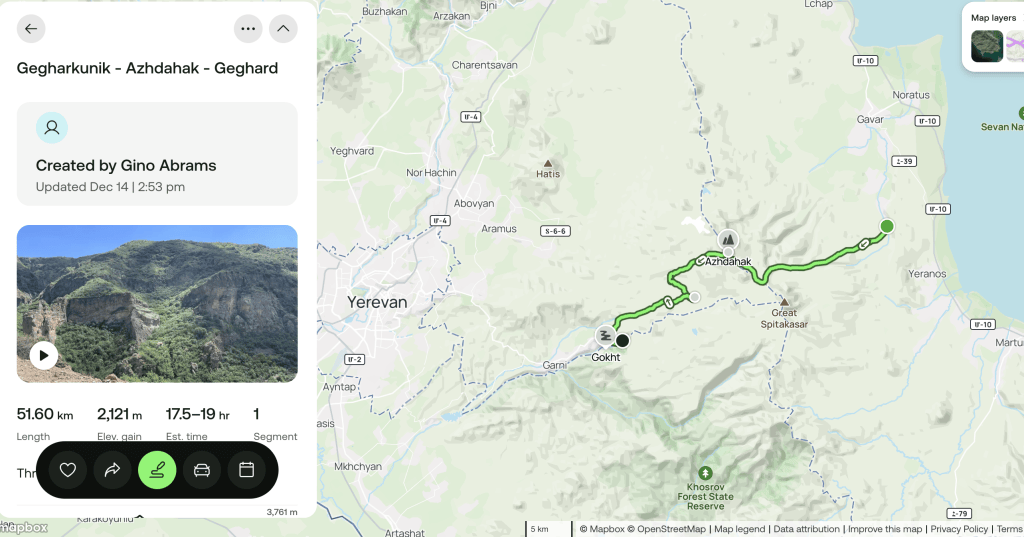
This summer, I set out with two of my friends, Cayden and Gino, to summit the fourth highest peak in Armenia, Azhdahak. Azhdahak is an extinct volcano that sits at 11,800ft in the Gegham mountain range, spanning between Kotyak and Gegharkunik marz. The name Azhdahak comes from Iranian mythology, an Armenianized pronunciation of a name that meant dragon, viper, or demon.
In the highlands that surround this red peak, ancient dragonstones and petroglyphs can be found in green fields, still holding onto wildflowers late into the summer. Clusters of white tents belonging to the Yazidi ethnic group sit in valleys with herds of animals a hundred strong. The sun is harsh, but snow still clings to the peaks here. Its melt runs into mirror-like high-elevation lakes, cooled in the evenings by wind and fog that rolls in over silent terrain.
The night before our hike, we packed our things and spent much of the evening convincing Cayden’s host mom that it was possible to do all this on foot and that we weren’t crazy. Arev interrogated us about food, where we would get water, and told us that we would run into bears, rabid dogs, and snakes on the trail. That afternoon she had already resigned to our adventure, and prepared homemade gata for the trek. At some point, our host families learn to accept our American death-drive for adventure.
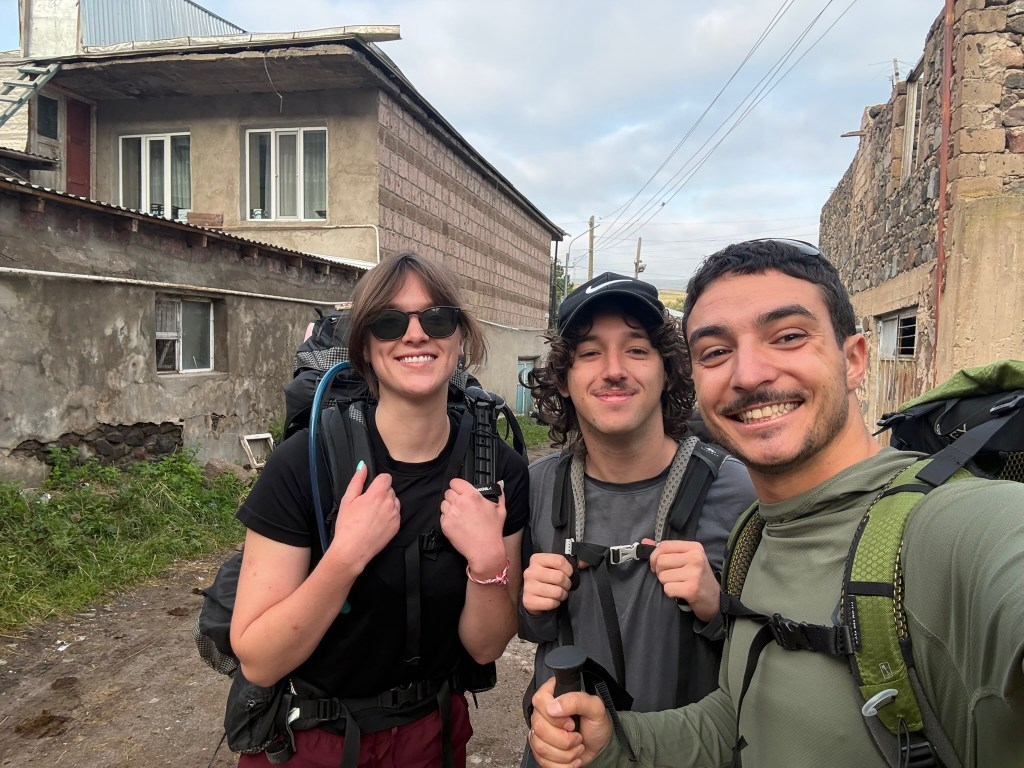
We started early and were met with a few stares from the shepherds of the village, the only ones up at the same hour. The beauty of being in an Armenian village is that nature surrounds you. Take a 10 minute walk from the town, and you’re in the mountains. This is how our trek started, on a maintenance road leading into the Gegham foothills.
It’s amazing how quiet it gets out in the country. My site is a city, there are always cars honking, kids playing in the street late into the night, people arguing on street corners. For Cayden in the village, it’s a different kind of disturbance. Cows mooing, dogs barking and fighting, the sound of his host mom waking up at 5am to start pulling potatoes from the earth. The mountains seem to deaden sound, even the pull of the wind is silenced in its stone and grass cover.
The terrain had a very gradual incline for the first half of the day. Cayden’s village shrank behind us, and we began to see the tin roofs of Gavar shining in the distance. Then, we had our first interaction on the trail.
A man waved to us on a horse. He was Armenian, from Gavar. We spoke to him, learning that he was taking his sheep out to pasture. We explained that we were heading to Azhdahak on foot, and again we were told we were crazy and that there were bears and snakes on the trail. The man then invited us to his home, a small shipping container structure, he said his wife would be waiting with coffee to share. Politely, we declined, then he cracked the whip he was holding and went back to his animals.
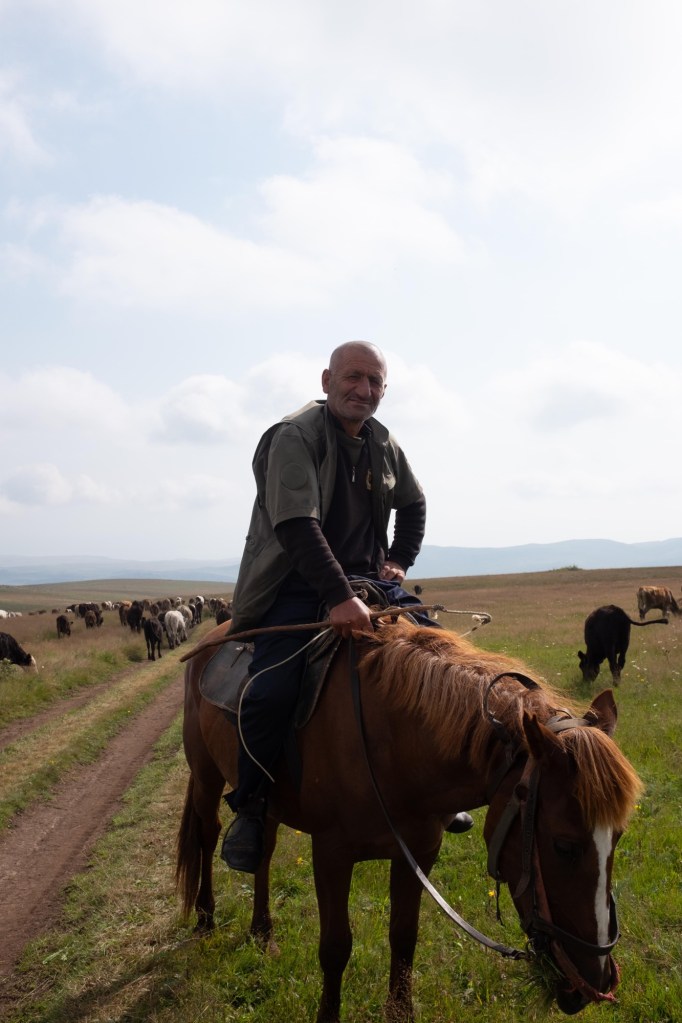
We walked another hour to lunch by a small river. While we were munching on almond butter and black bread, an old Soviet UAZ-452 came bouncing across the plains and rocks, slowing to stop by the river.
“Where are you guys headed?” Asked the man in the passenger seat, in perfect English.
“Azhdahak.”
“Do you need any help?”
“No,” We answered
“Vodka? Let us give you a shot of Vodka.”
We paused and looked at each other. It was 11am. We waved the guy off, and shrugged our packs onto our shoulders. I have a theory about Armenian hospitality, that if you deny it, it’ll return to you threefold. There is never really an option to say no.
Later, after lunch, a hand waved above the shaggy wool backs of fifty-some sheep,
“Salaam!”
Another man appeared on horseback. We tried speaking to him in Armenian.
“Iran, Persia!” he said, setting off into curling Farsi that we couldn’t understand.
He was tanned from the mountain sun, with shiny white teeth and dark hair covered by a scarf and hat. Cayden asked if he could take a photo of this Persian John Wayne, holding up his camera and miming a capture.
“Ok!” John Wayne chirped, flicking his horse’s reins, riding back to his herd of animals before Cayden got the shot.
We continued, already surprised at the people we had met on the trail. Cayden was hoping to see some Yezidis, his host family had a connection to the group. As we passed by Great Spitakasar two more vans ran by. We moved off the path to let them pass and for a moment we were free, the van continued down the maintenance trail, only to shift into reverse gear a few meters ahead of us.
Six men hopped out of the van, beers in hand. Heineken, imported. Good stuff that we don’t like to justify on the Peace Corps budget.
“Where are you going?”
“Azhdahak. On foot.”
“You’re crazy, don’t you know there are bears out here? Take these beers.”
We took the Heinekins and had a toast, they were warm, and the foam spilled over our hands and onto our already dirtied clothes. Gino thanked them for their hospitality.
“Can’t we take you to Nazeli lake?” Our campsite for the night. “We’re making xorovats. Come join us.”
We declined the ride and said we would meet them in a couple of hours. The vans began to crawl up the ridgeline, sitting in front of us, the rest of the elevation gain for the day.
It took a few hours and a short argument about an alternate path to get to Nazeli Lake, then we spotted the two vans by its shoreline. We took off our packs for the day, one of life’s greatest reliefs if you’ve had the pleasure of experiencing it, and sat with our new friends.
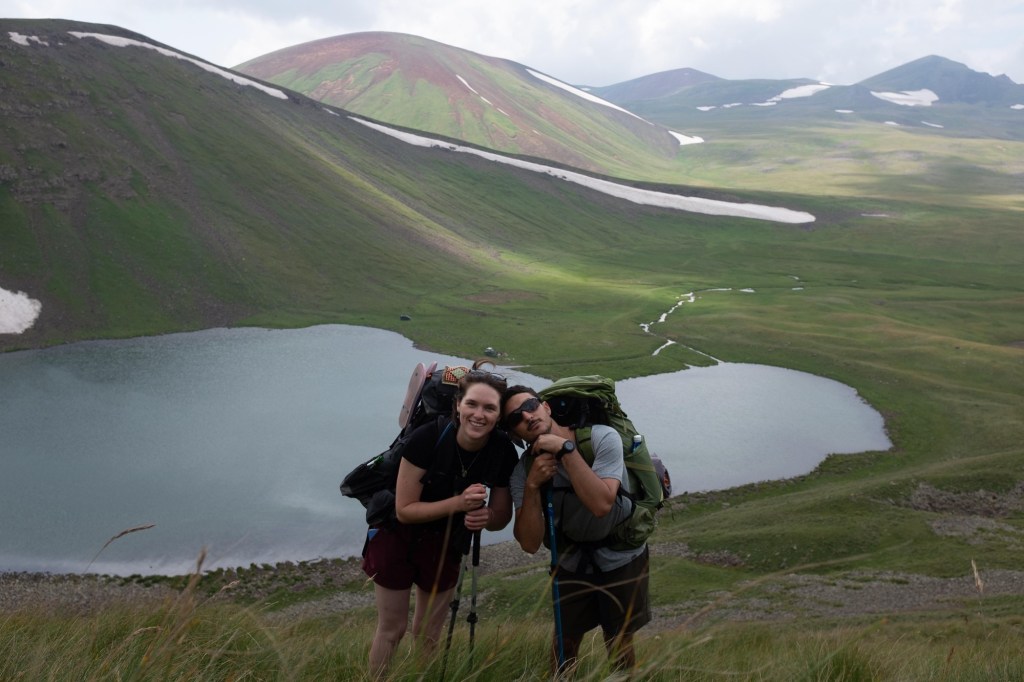
They were a group of coworkers, a коллектив (collectiv), having a yearly award ceremony. We took a minute explaining why we’re in Armenia, why we speak Armenian when we’re not Armenian, that yes we’re going to do the whole trail on foot, finding out which of the collectiv members were related to Cayden’s host family, and the other Peace Corps Volunteers they’ve run into, trying to fit all this information inbetween toasts punctuated with vodka, paklava, chicken, lamb and pork xorovats wrapped in lavash and dipped in its own fat.
Ramen and almond butter, our planned dinner, paled in comparison to the colletiv’s leftovers. Half a watermelon, the rest of the pork and chicken xorovats, a bundle of lavash and matnakash, cookies, paklava, 10 small bottles of Coke, Sprite and Fanta, and two bottles of vodka. One mass-produced and the other homemade (which can reach up to 80 proof). We would eat like kings for the night, and only for that night because our packs were already heavy with our own foodstuffs.
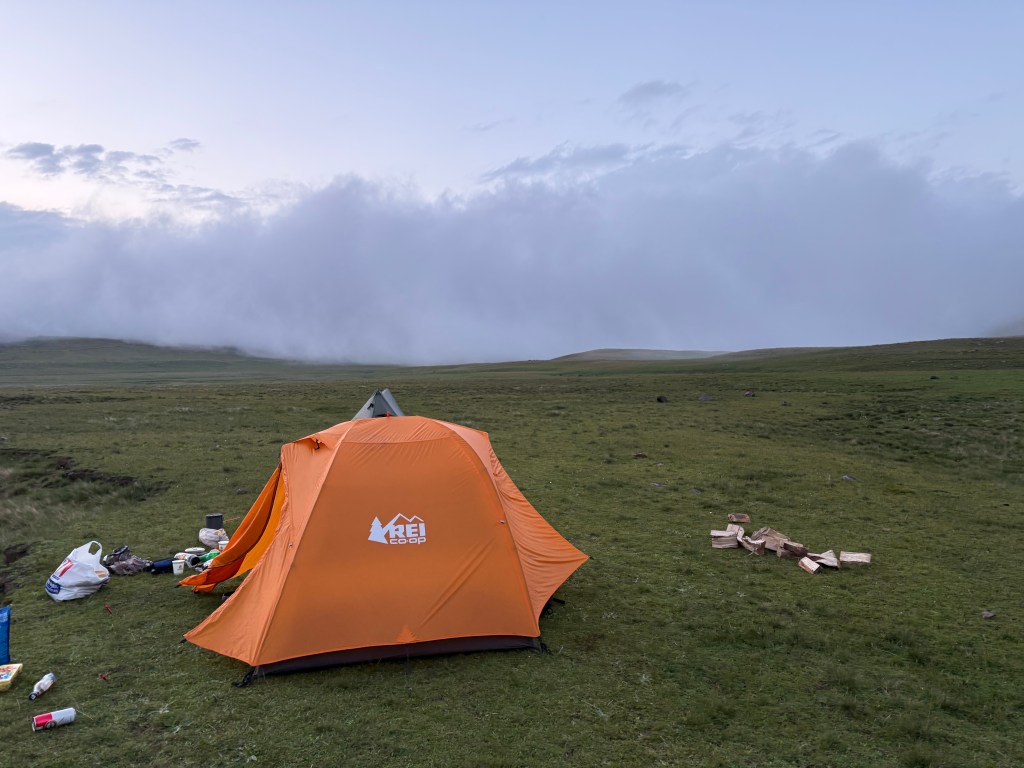
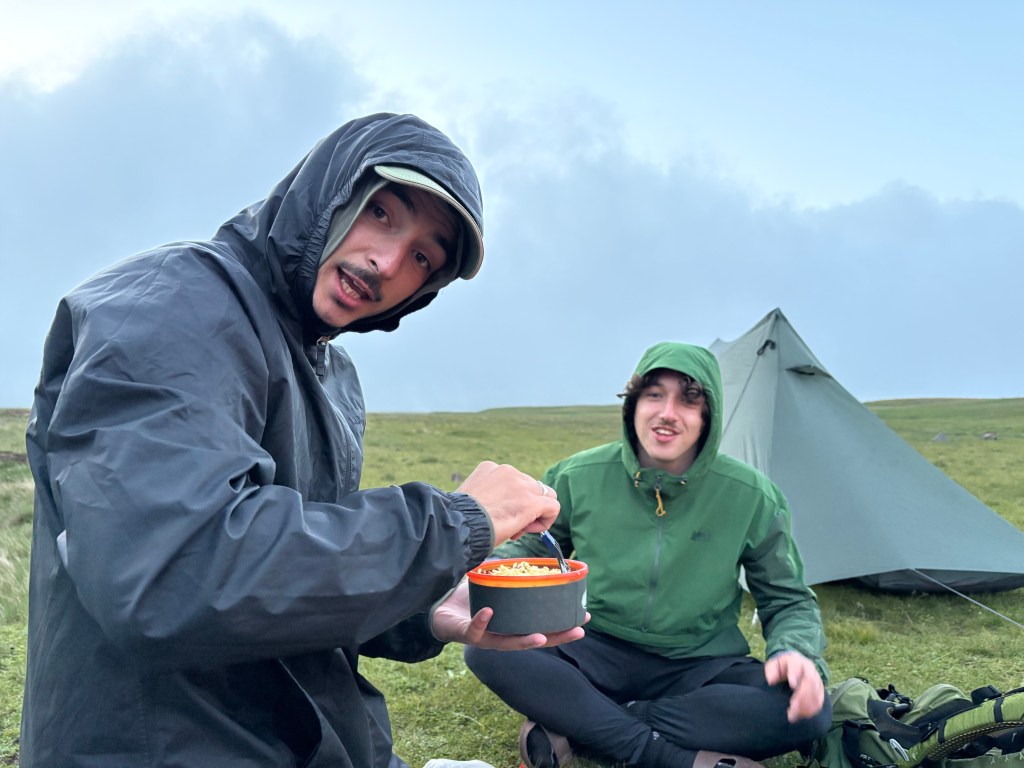
setting up camp before the fog rolls in
We ended our day with a quick swim in the freezing lake, full bellies and a fog blanket that rolled over the mountains in minutes. We recapped the day in our tent: the man from Gavar, the men who offered us vodka, John Wayne, the collectiv. We hoped we made just as interesting stories and strangers for these people. Three strange foreigners, half-crazed Americans carrying their belongings on their backs, thirsty for punishment, and lacking the common-sense fear of bears or snakes.
The next day started off with filtering water, tearing down camp and ignoring the wear and tear on our bodies, quickly accumulated over the past 24 hours. Our backs ached, our hips were bruised from the weight of the packs. Cayden and I discovered nasty sunburns on the backs of our legs, a blind spot in our sunscreen application. Gino was spared from this fate, something we moaned and whined about because Cayden and I are class A complainers.
The first few steps of the day were excruciating. We needed relief, and quickly. Gino only had a few songs downloaded on his phone, the anthem of our trip was decided. We took the ascent in stride at first, scrambling over rocks and keeping a keen eye for petroglyphs and dragon stones.
Our pace flattened as we got closer to the peak, and the ascent became grueling. After stopping for a quick snack of pistachios and a few rounds of I Am a Rock, we had more energy.
Cayden is an ultralighter, obsessed with grams. He sawed off half of a toothbrush and offloaded his supplies to Gino to keep his pack as light as possible, which paid off near the summit. Gino and I were left in the dust, breath short from the altitude and none to spare for complaining. Asthmatic and averse to physical hardship, I was the last to arrive. We had a clear view of our campsite from the night before, and the slow ascent in the morning meant each step was earned.
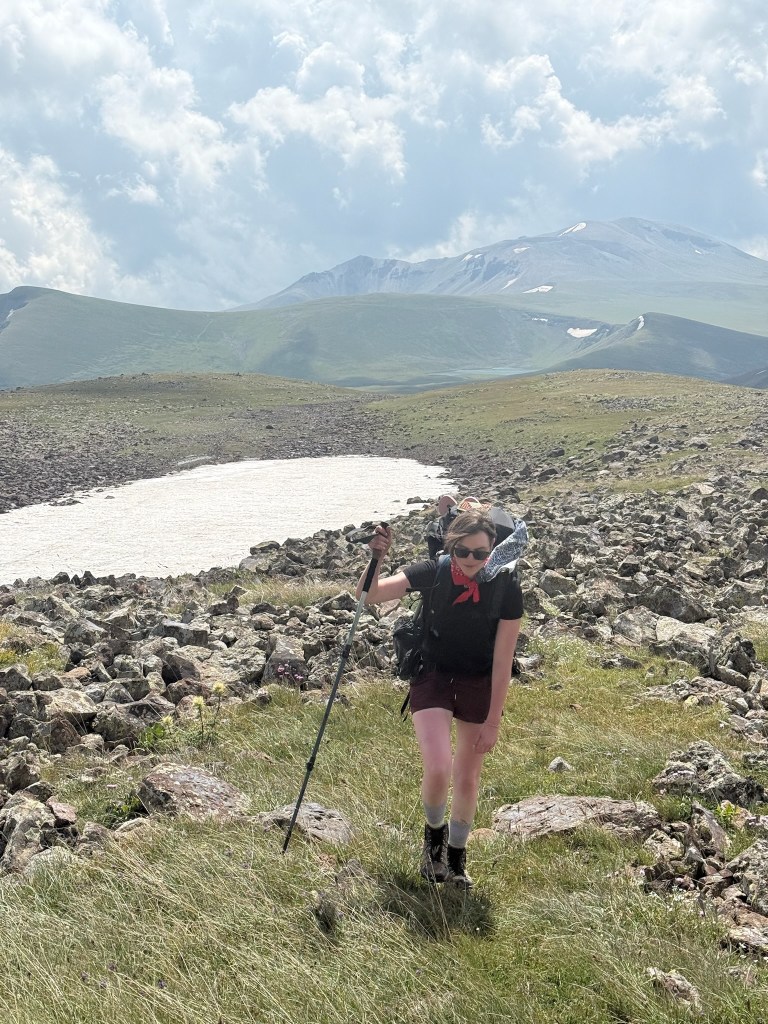
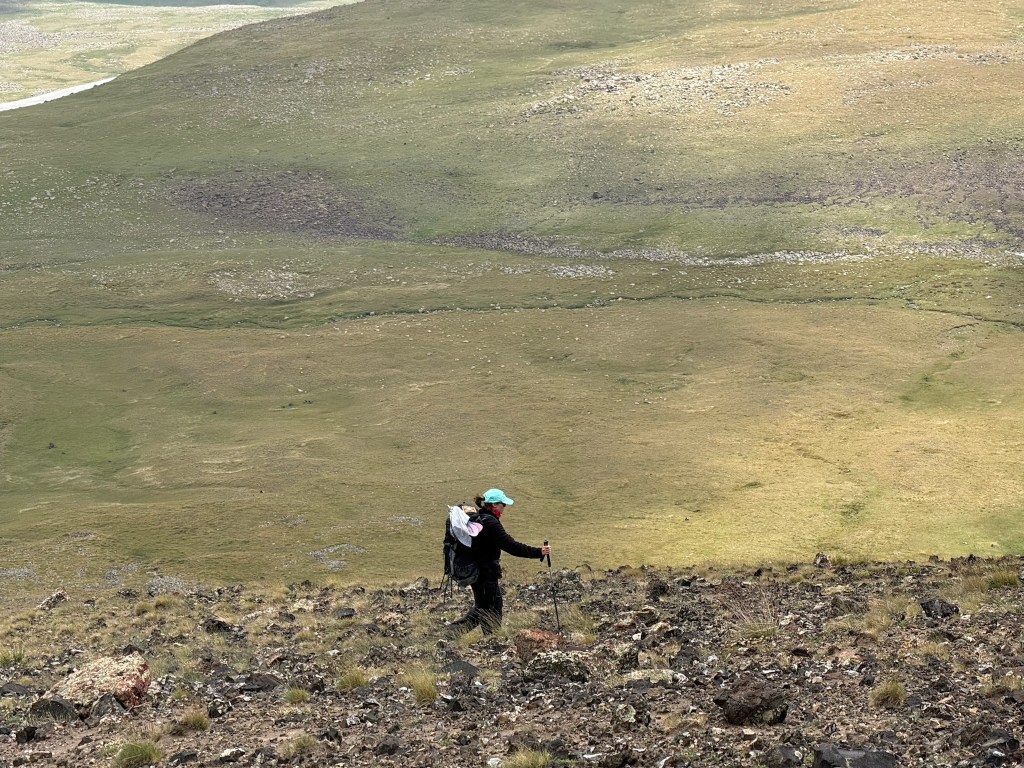
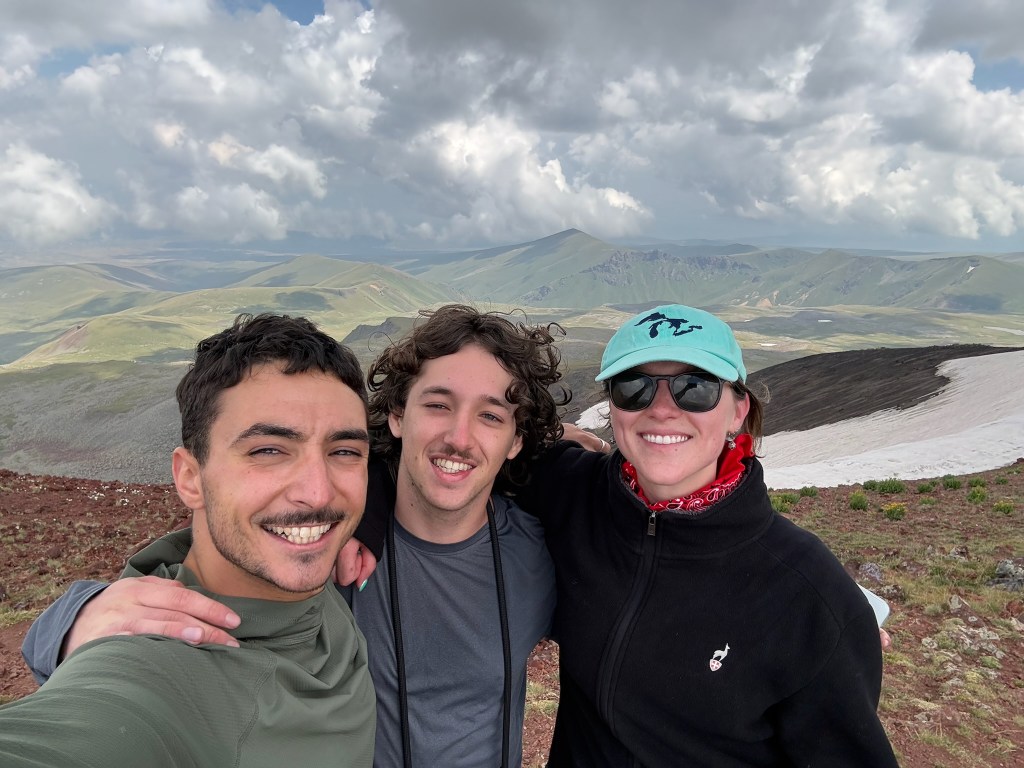
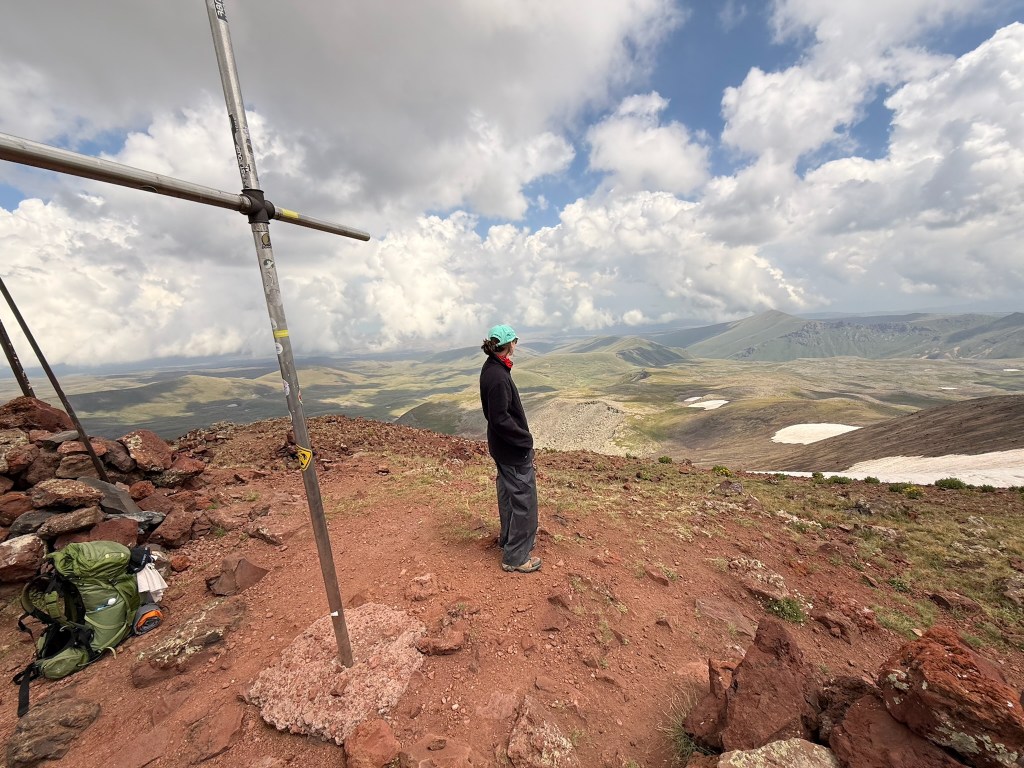
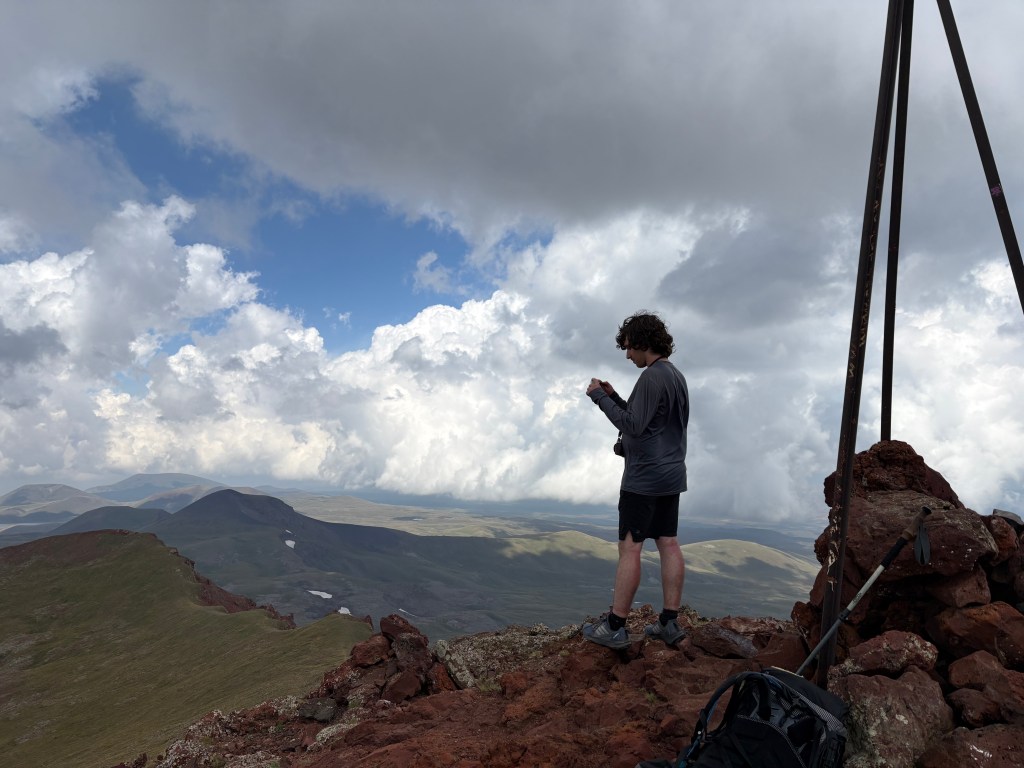
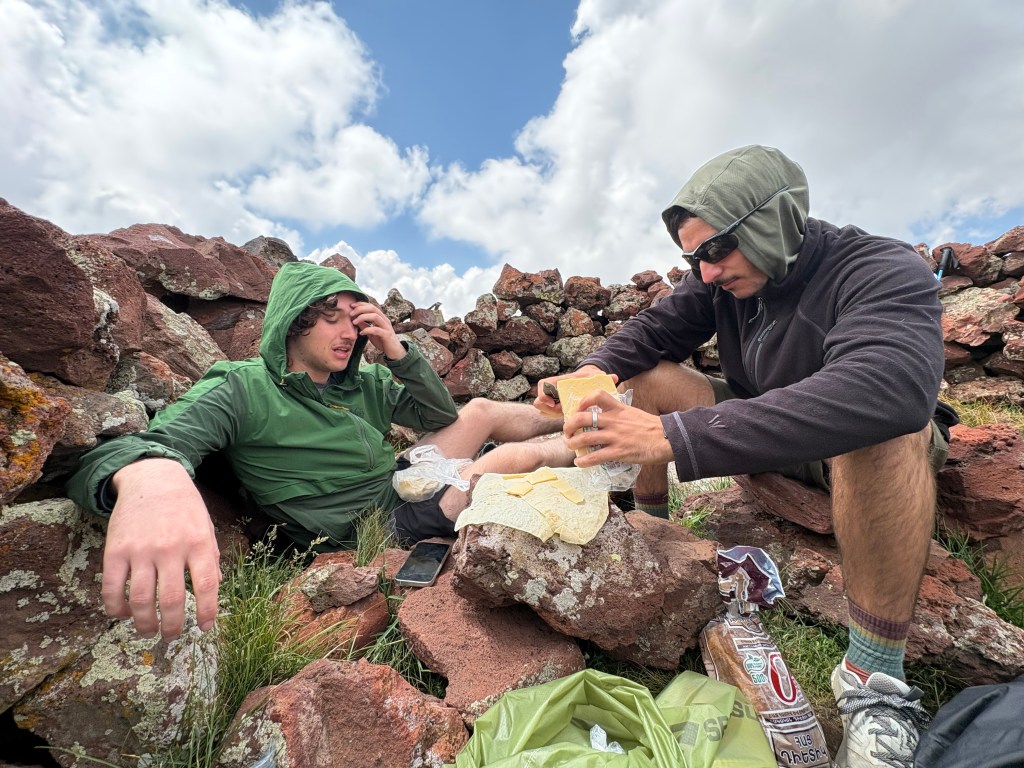
At the peak of Azhdahak, the terrain changed dramatically. On the Nazeli side, it was grass-covered, gradual hills. We took a moment to rest after the ascent and had lunch on the peak. Lori cheese, leftover lavash, sausage, and of course, a trail beer to celebrate. From where we stood, we could see Nazeli, Gavar, and the hazy shoreline of Sevan in the distance.
In Armenia, I’ve had two birthdays. I’m getting older and more aware that youth is a type of wealth. Backpacking magnifies that wealth, helping you understand what you’re capable of. Hopefully I’ll have the health and energy to do this late into life. How lucky I was to be young, to be healthy and to be here with friends.
Descending the mountain, the rocks turned red and the soil dry and loose. Beautiful orange poppies and other resilient wildflowers clung to life. Cayden and I slogged down the trail, muttering, trying to keep our footing and failing as Gino ran ahead.
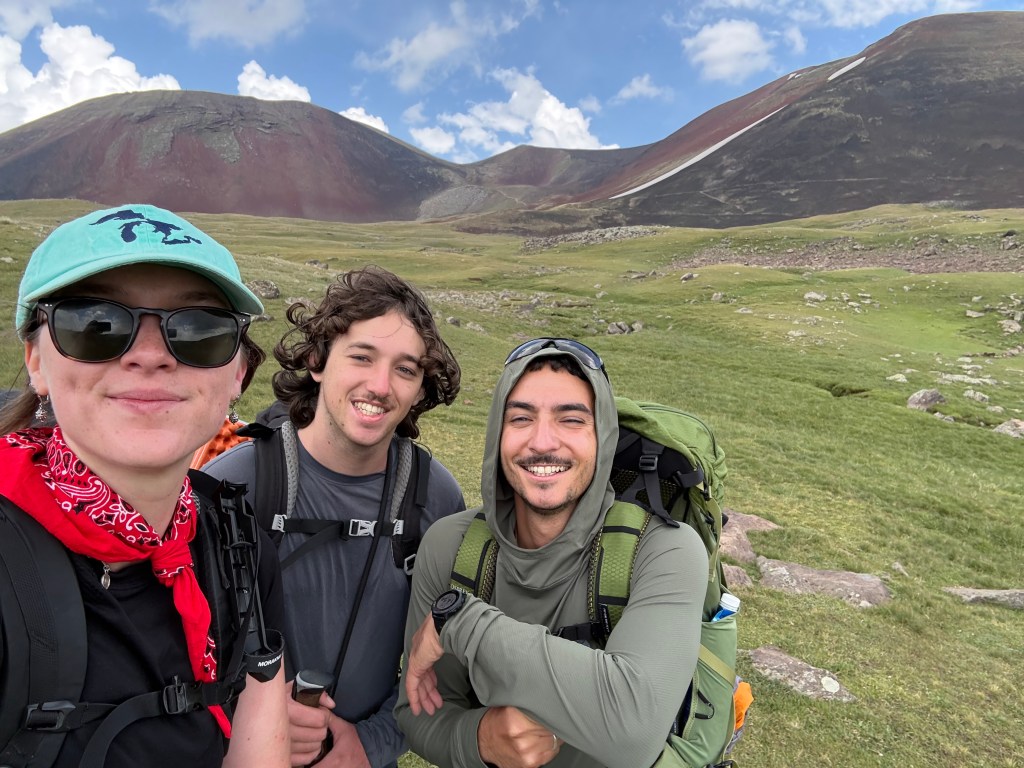
After hiking a steep incline all day, the flat plain that lay in front of the mountain felt pillowy on our feet. The ascent had taken up most of our water, and we walked, searching between the stones and on the map for a river. We continued downwards, the terrain becoming more arid, passing more tents on parched fields.
With less than two liters between the three of us, thinking of what to do next, a young girl waved us into her home. We walked into the tent, curious to see the inside. It was modest. Dirt floors, many beds and a wood-burning stove in the center. The girl’s grandmother welcomed us, and a pot of coffee was put on the stove instantly.
We drank coffee together, and picked at an overflowing bowl of candy that the grandmother kept insisting we take from. They lived here May through August, taking care of their sheep. The grandmother’s husband worked with the animals, she proudly told us he was a polyglot, speaking German, Russian, Armenian and English. She pressed us to stay the night with them in their tent. Not only do you meet kind people in Armenia, but you also meet interesting, educated ones.
The girl filled our water and we stood to leave. Gino thanked them for their “Armenian hospitality”
“But we’re not Armenian.” said the grandmother. “We’re Yezidi.”
In the span of 48 hours, we had met Armenians, a Persian, and now Yezidis. This is highly unusual for an extremely homogeneous country; 98.1% of Armenia’s population is ethnic Armenian.
More trekking. Less and less water. Applying sunblock on the hour, every hour until we crashed on a flat plateau. The whistles of the shepherds calling their herds in for the night echoed long and far. An evening breeze cleared the haze, and Ararat rose, dusky and proud in a purple shroud.
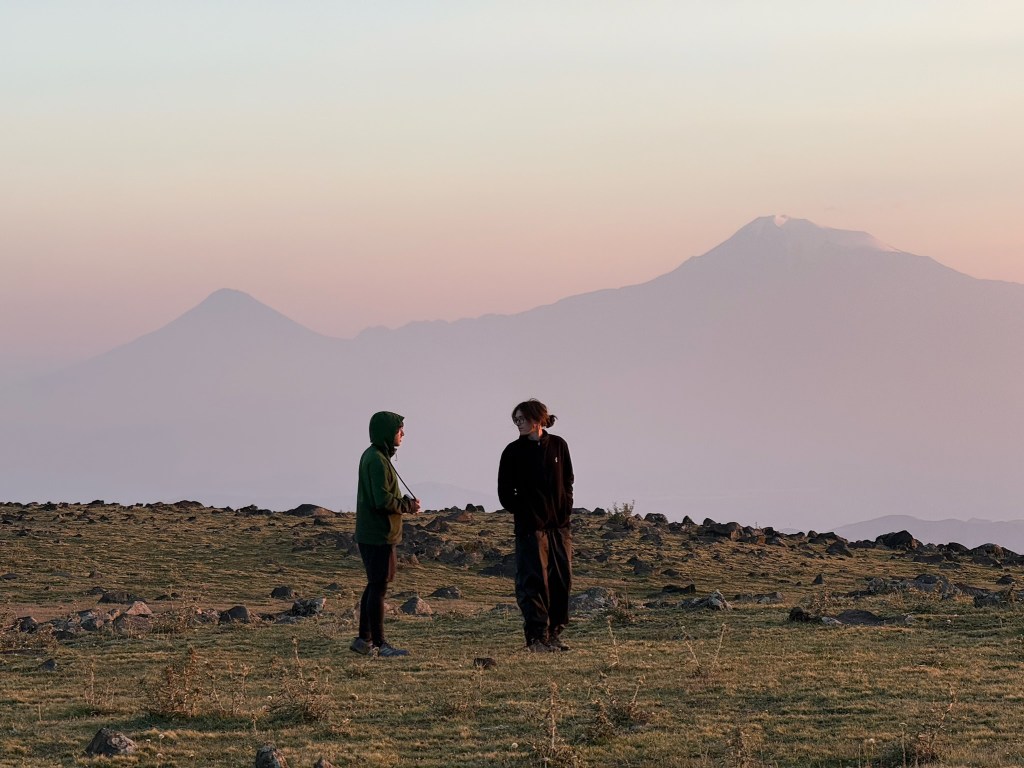
The last day of our trek, we didn’t last a mile before we were again waved to a tent.
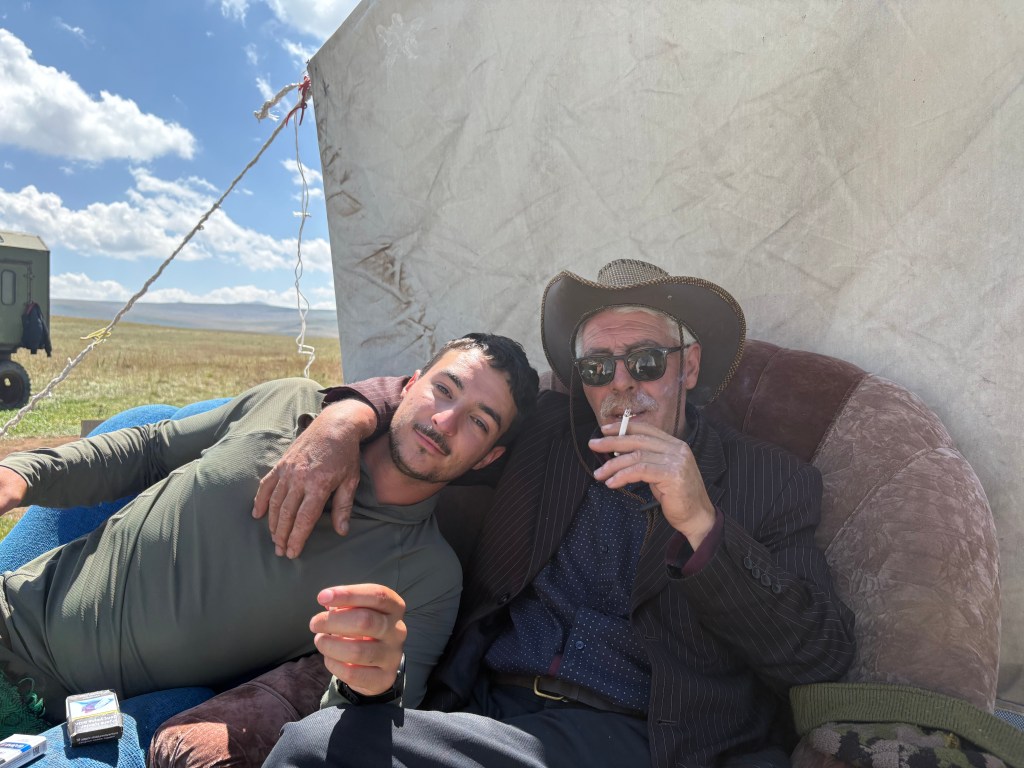
“What the hell are you doing? Sit down, idiot.” These were the first words of the Shex. We could hardly understand him at first, his voice was gravel.
“I can tell you’re real men, you both have mustaches,” said the man, gripping Gino and Cayden’s hands in a vice and tugging on them, almost toppling them over. He was barely five foot four, stocky. He wore a cowboy hat. When I sat down, he stole my sunglasses for his own.
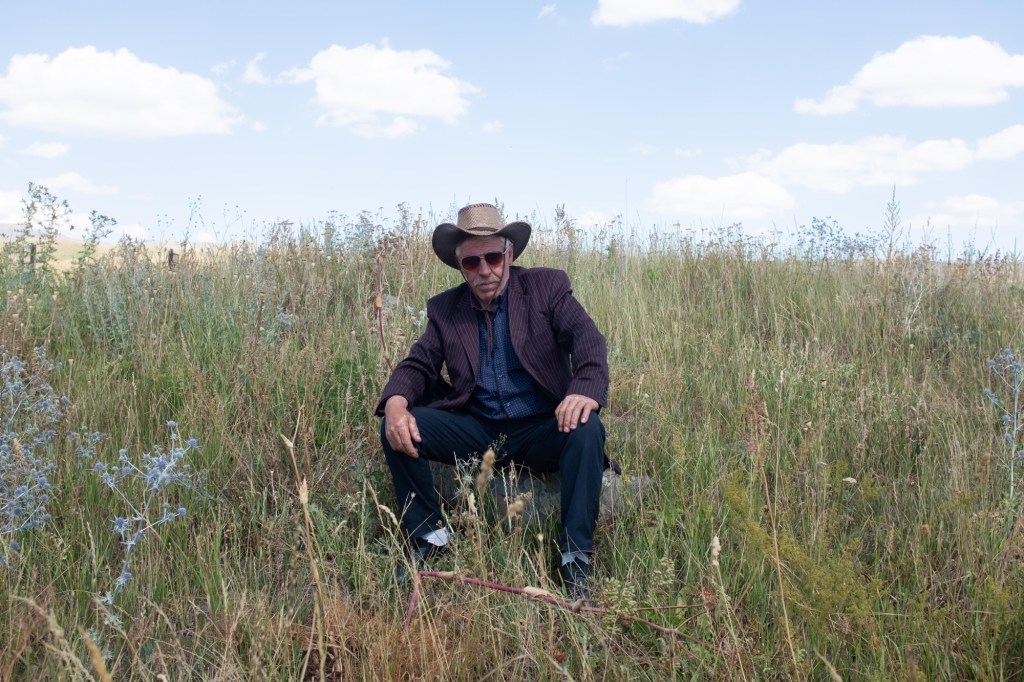
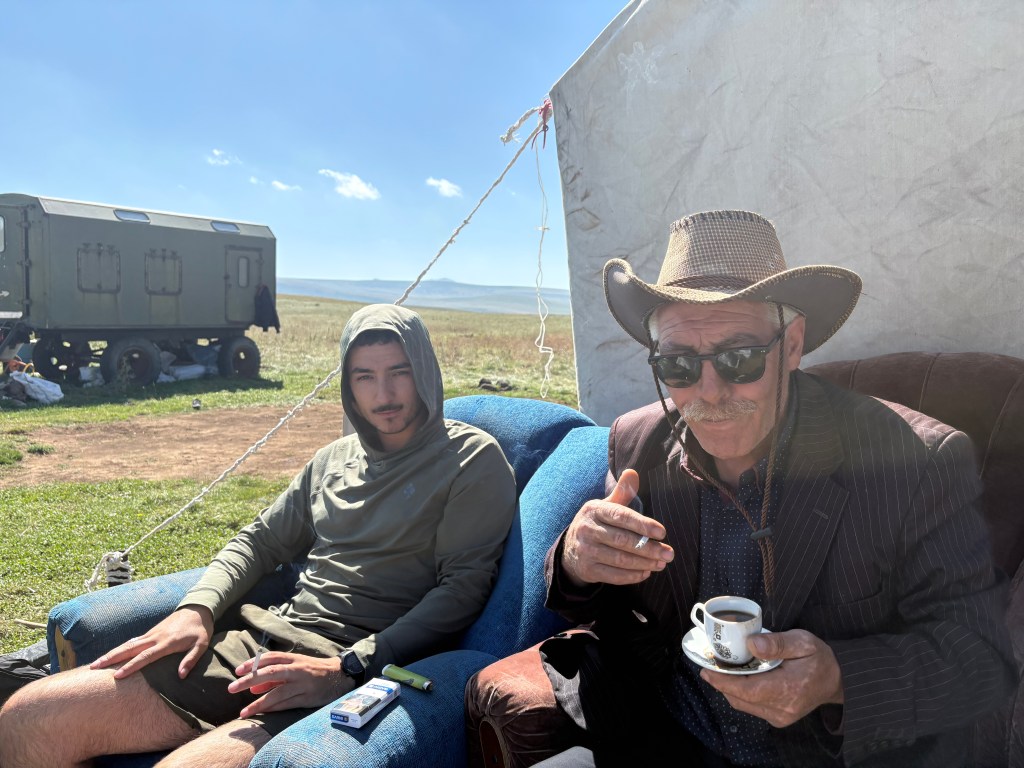
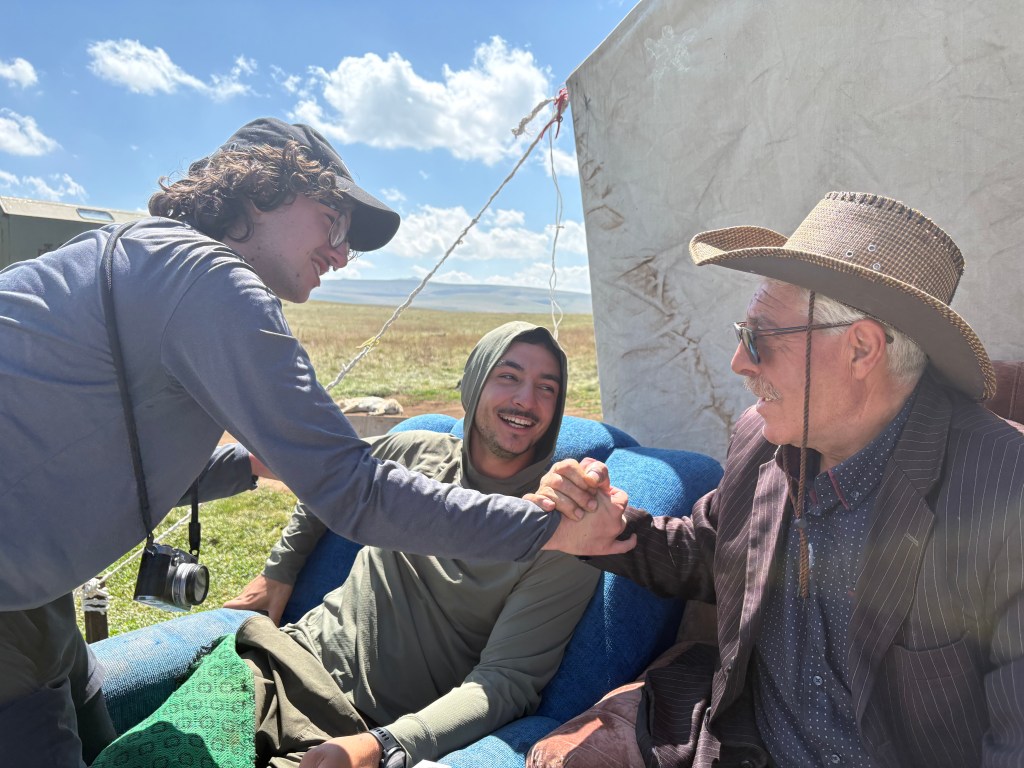
“You, you need to cover your legs, and grow your hair long.” He threw a white cloth at me. “Shame.”
I reluctantly pulled the cloth over my legs, telling myself it was protection from the sun.
“Where did you come from like this?” He asked us once our packs were on the ground. The Shex sat on his throne, a plush chair just outside of his tent. One of his grandsons appeared with coffee, watermelon, and candy for us.
“From Azhdahak, we came on foot.” We waved towards the mountain.
“Azhdahak, I’ve never heard of it.” It had been 15 minutes, he was smoking his third cigarette, which Gino eagerly lit for him. The watermelon was soon replaced with fresh sheep’s cheese, bread, tomatoes and cucumbers .
“What do you mean, it’s just over there.” The mountain was still in view.
“No, Azhdahak is here. I’m Azhdahak.” He banged on his chest, hard. “I have no parents, I was born from that stone.” Simon and Garfunkel’s words had come true.
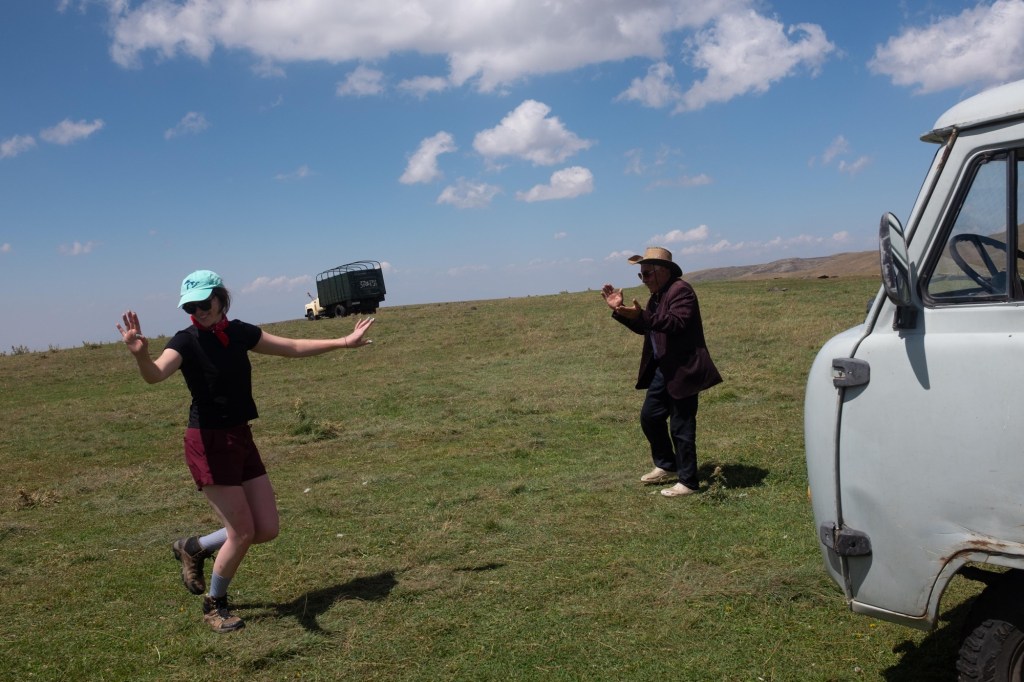
The Shex’s grandson was going to Geghard and offered to take us with him. We became hostages for the day. What ensued after this was more than six hours of drinking, smoking, eating, dancing and lectures.
“The Shex is speaking.” He would say to us, extinguishing our English crosstalk.
The plateau we were on apparently revolved around this man. We learned he was Yezidi, and an important one at that. Soon after sitting down for coffee and cognac (it was 9:00am), the neighbors came by. One man approached the Shex, kissed his hand and pressed it to his forehead. After the cognac came vodka, homemade and tinted green. Toasts were made in Yezidi, and blessings too. A Shex is considered a spiritual and religious leader, drink was the medium of prayer.
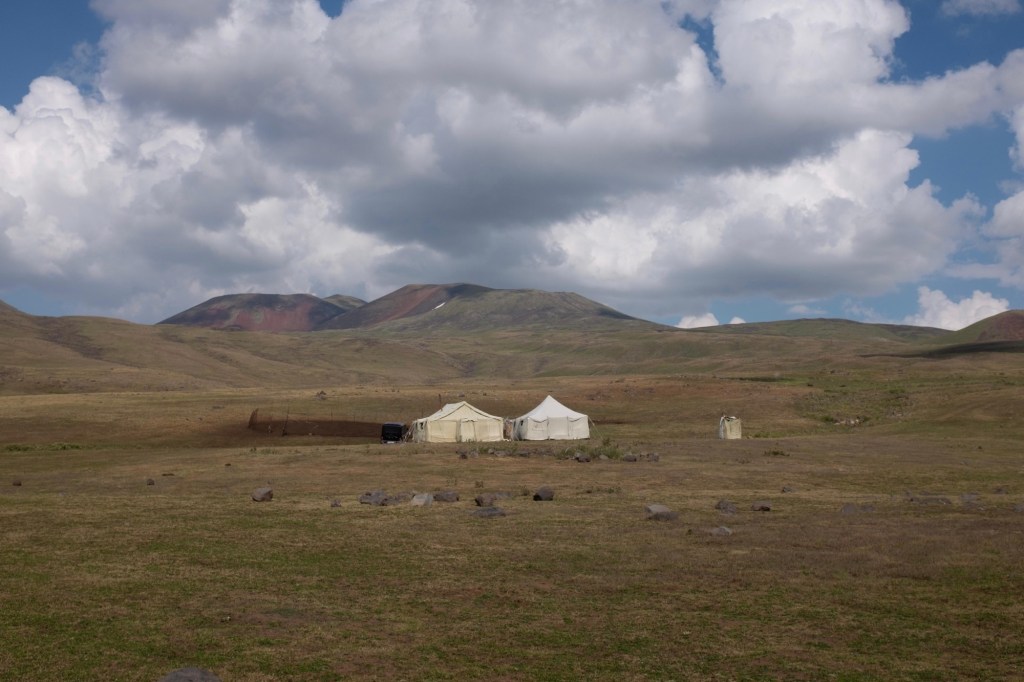
Yezidism is a monotheistic religion, with a lesser pantheon of 7 angels. The sun is recognized as an expression of God’s creativity and power. They are an ethnic group that has been persecuted and scapegoated for much of history, prominently in Iraq, where they are wrongly considered Satan worshipers. Fleeing their homeland, about 30,000 live in Armenia, mostly in the Kotayk region.
At some point, my dowry was negotiated, as if I hadn’t had enough antiquated misogyny directed at me. It started at half a million dollars, which Cayden refused. It rose steadily until it reached three million and 15 sheep. The Shex discussed marrying me off to his grandson or the neighbor, Narek. I liked Narek better.
“Only good for my granddaughter,” said the Shex. “Are?”
“Are.” We agreed. The Shex had been peppering in Yezidi words all day, testing to see what we could remember. Are, yes. Zafranzoisma, thank you. Sharma, shame.
It was late afternoon and suddenly we were sick of the Shex. We had been drinking ferociously since the morning, and were beginning to feel drunk and hungover at the same time, sitting outdoors and baking in the sunlight. I could feel my sunburn intensifying through my modesty cover. I placed another blanket on my lap and earned a nod of approval from Azhdahak himself.
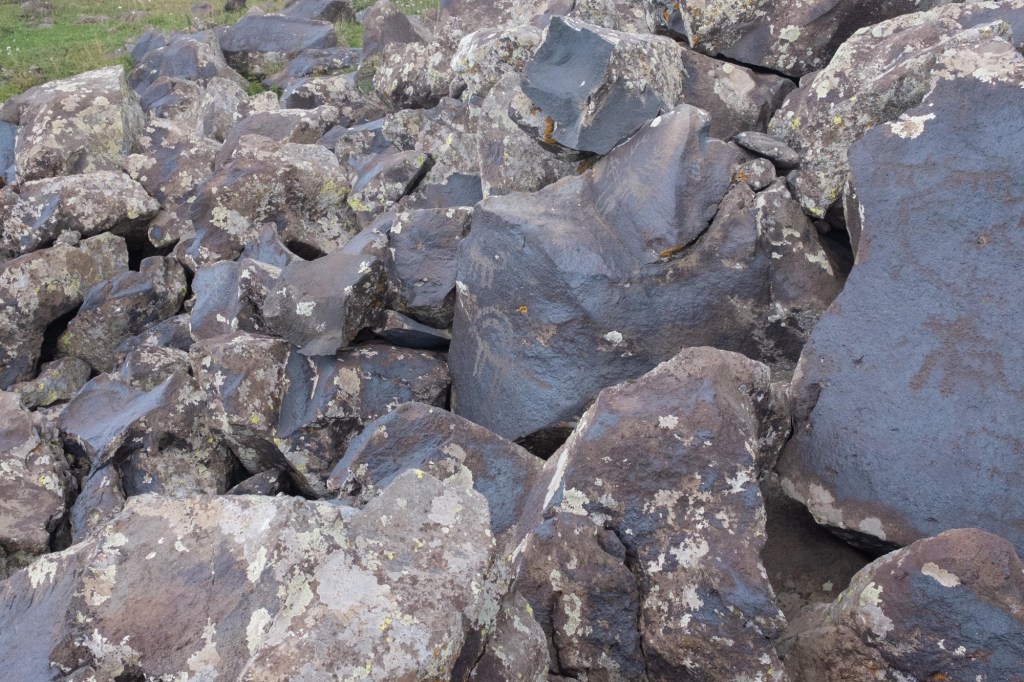
His grandson appeared from inside the tent, and offered to show us what we had spent much of our time looking for: petroglyphs. Cayden and I scrambled over the rocks with this man, as he pointed out several figures of men hunting and long horned sheep scratched into the ancient stone.
Between conversations with the grandson about how I really, truly, did not want to get married I tried to understand the scale of what sat infront of me. Armenia shocks you with its history. America just celebrated its 250th birthday, the carving in front of me was likely from 2,000 BCE.
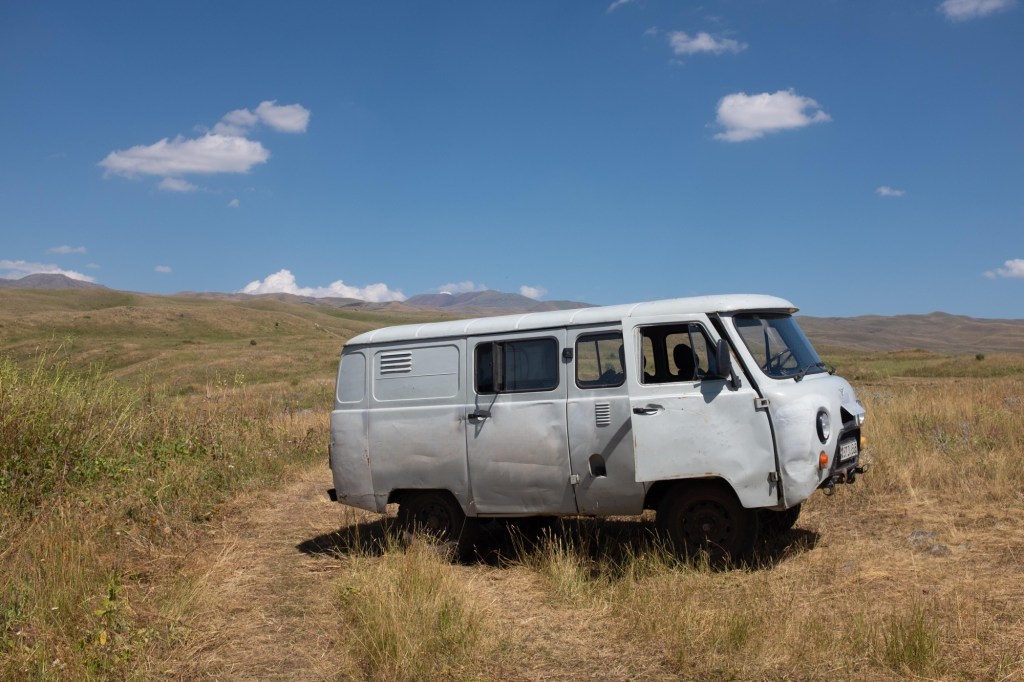
After a quick sheep sale, the grandson came back, this time with the van. We stood, our escape hatch was opening. We piled into the back of the van, vision swimming green from the homemade vodka. The Shex sat in his throne, speaking to himself.
The grandson spoke, he was typically quiet. “One second, he needs a cigarette then he’ll get in the car.” The Shex was coming with us.
The ride was rough. The roads were unpaved and rocky and we were thrown every which way in the backseat. We pounded on Cayden’s back to keep him from being sick and clung to each other for balance. Gino careened towards the front seat, still lighting cigarettes for the man.
Slowly we descended the plateau, stopping often for smokes, to use the bathroom, and even a brief visit to a Yezidi cemetery. We rolled into Geghard, finally, the end of the trip. We couldn’t take much more. Another stop for a meal, another tribute for the Shex with cognac, bread, and zebra-striped ice cream. Finally, after hours,
“We’re three minutes away from the campsite.” The van had stopped again. We could see the entrance, a fancy yurt and a pool waited for us, we tried to convince the grandson to keep going. Paradise was within view. Freedom from the Shex was possible.
“Get out, or the Shex will get angry.” Suddenly the grandson’s well of patience made sense. We stopped for five minutes so the Shex could take two sips of a warm beer. The grandson discreetly took the can and handed it to me, out of his grasp. Then, back into the van.
We drove the remaining three minutes. The Shex was finally tender, his grip wasn’t crushing when he said goodbye. He gave us handshakes, kisses on the cheek, and called us his grandchildren. He said to visit him in Yerevan and come back to the plateau next summer. Stockholm Syndrome suddenly made sense to me.
We waved goodbye to our grandpa, and entered the campsite. A cherubic Dutch lady opened the gates of Eden for us. A long shower to scrub off the grime, a dip in the pool and a shawarma from a restaurant next door had us brand new. Our trip had come to an end.
40,000 some steps, 30-some miles that we only ended up hiking 20 of. 2 friends, a handful of replays of the same song. I’d lost count of how many people had fed us before we’d asked. Vodka in the morning, vodka at noon, vodka tinted green and pressed into my hand by a man who called himself a mountain and considered me kin. You can’t refuse Armenian hospitality, or even Yezidi hospitality, it only comes back stronger.
I wanted to take a second for a few thank yous, first to Cayden for bringing his camera along on the trip. We joked about being in ‘the moment’ alot, but I’m so glad all of this is documented.
Second, to Shant, thank you so much for letting me borrow your pack & gear! I couldn’t have done this trip without you axpers.


Leave a Reply, Email is Not Recorded